
Databases are the backbone of almost every modern application. Whether you’re shopping online, using a mobile app, managing student records, or accessing your bank account, databases are constantly storing and retrieving information behind the scenes.
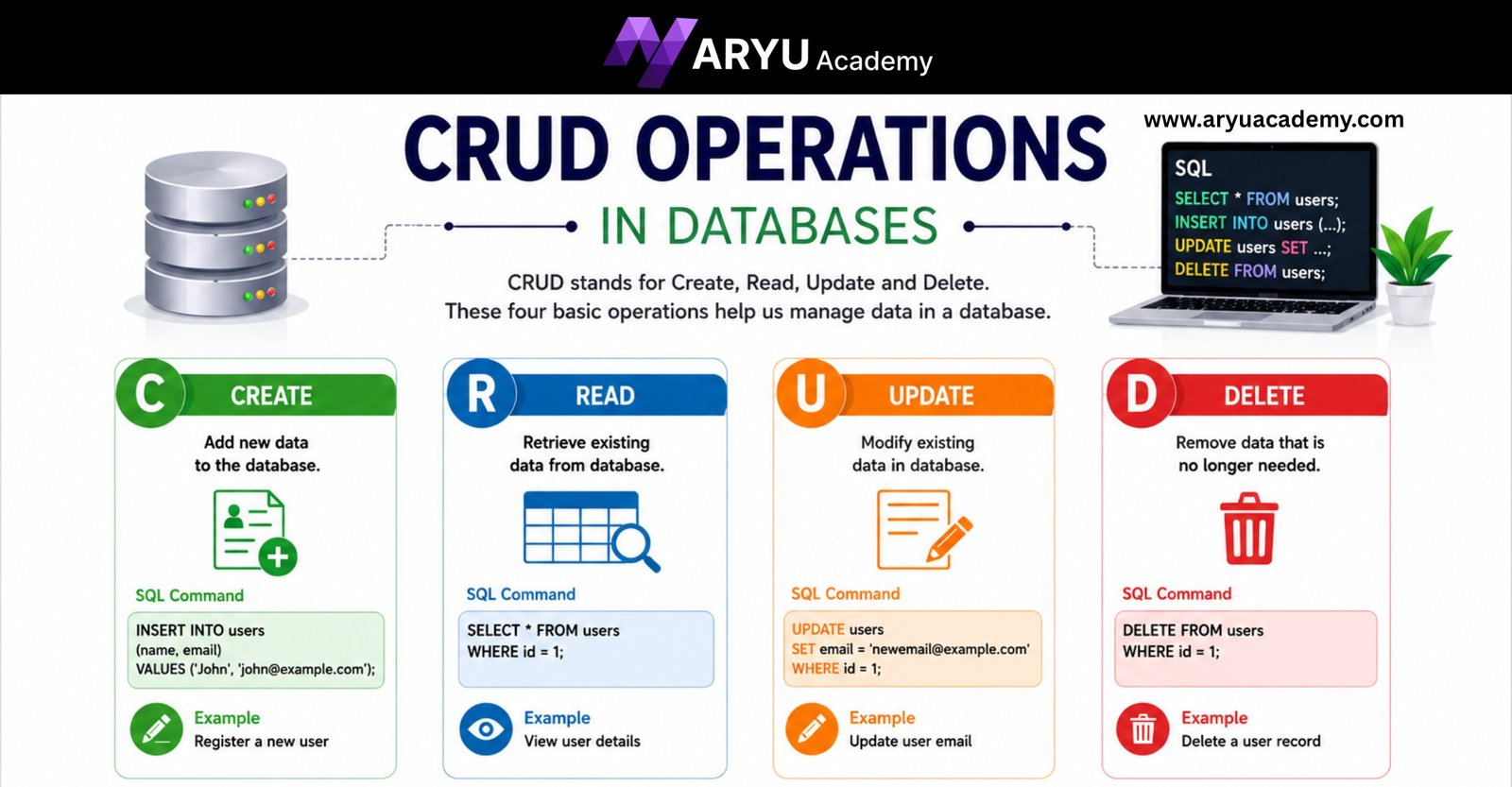
At the heart of every database system are four essential operations known as CRUD: Create, Read, Update, and Delete. These operations allow applications to manage data efficiently and ensure information remains accurate and up to date.
If you’re learning SQL, database management, or software development, understanding CRUD operations is one of the first and most important concepts you’ll encounter. In this guide, we’ll explain each operation in simple terms, explore real-world examples, and share best practices to help you build a strong foundation.
What Are CRUD Operations?
CRUD is an acronym that stands for:
Create – Add new data to the database.
Read – Retrieve existing data.
Update – Modify existing records.
Delete – Remove data that is no longer needed.
Understanding the Four CRUD Operations
1. Create – Adding New Records
The Create operation inserts new information into a database. Whenever users submit data through a registration form, online application, or product listing, a new record is created.
Registering a new user
Adding a new employee
Creating a customer profile
Posting a blog article
Uploading product details to an online store
2. Read – Retrieving Information
Searching for products
Viewing customer information
Displaying student records
Checking bank transactions
Reading blog posts
Displaying order history
3. Update – Modifying Existing Data
Personal information
Contact details
Product prices
Employee records
Inventory quantities
Account settings
4. Delete – Removing Unnecessary Data
Deleting inactive user accounts
Removing discontinued products
Canceling outdated appointments
Clearing temporary records
Deleting duplicate information
Why CRUD Operations Are Important
CRUD operations are the foundation of every database application. Without them, businesses would struggle to manage customer information, process transactions, or maintain accurate records.
Efficient Data Management
CRUD operations make it easy to organize, store, retrieve, and maintain large amounts of information.
Improved Accuracy
Updating and deleting outdated information ensures databases remain clean and reliable.
Better User Experience
Users expect fast access to accurate information. CRUD operations help applications respond quickly to user requests.
Supports Business Growth
As businesses expand, databases grow larger. Well-designed CRUD operations allow systems to scale efficiently without compromising performance.
Simplifies Application Development
Most programming frameworks include built-in support for CRUD operations, making software development faster and more efficient.
Real-World Applications of CRUD Operations
CRUD operations are used in nearly every software application you interact with daily.
Some common examples include:
Banking Systems
Create new accounts
View account balances
Update customer details
Delete inactive accounts
E-Commerce Websites
Add products
Display product catalogs
Update inventory
Remove discontinued products
Hospital Management Systems
Register patients
View medical records
Update prescriptions
Remove duplicate entries
Student Management Systems
Add student records
Display grades
Update attendance
Delete graduated student records
Social Media Platforms
Create user profiles
Read posts
Update profile information
Delete comments or accounts
Best Practices for CRUD Operations
To build secure and reliable database applications, developers should follow these best practices:
Validate User Input
Always verify data before storing it to prevent invalid or harmful information from entering the database.
Protect Sensitive Data
Use authentication and authorization to ensure only authorized users can update or delete important records.
Create Database Backups
Regular backups help recover valuable data in case of accidental deletion or system failures.
Optimize Database Queries
Maintain Data Integrity
Use constraints and relationships to keep data accurate and prevent duplicate or inconsistent records.
Monitor Database Activity
Tracking CRUD operations helps identify errors, improve performance, and maintain security.
Common Mistakes Beginners Should Avoid
Forgetting to validate input
Updating the wrong records
Deleting data without backups
Creating duplicate entries
Writing inefficient queries
Ignoring database security
Failing to use transactions for important operations
Conclusion
CRUD operations are the building blocks of every database-driven application. Whether you’re creating new records, retrieving information, updating existing data, or deleting unnecessary entries, these four operations make it possible to manage information efficiently.
For anyone pursuing a career in software development, database administration, or data management, mastering CRUD operations is an essential skill. By understanding how these operations work and following best practices, you’ll be able to design secure, efficient, and scalable applications that meet real-world business needs.
As you continue learning SQL and database technologies, practice implementing CRUD operations in small projects. Hands-on experience will strengthen your understanding and prepare you for more advanced database concepts.