
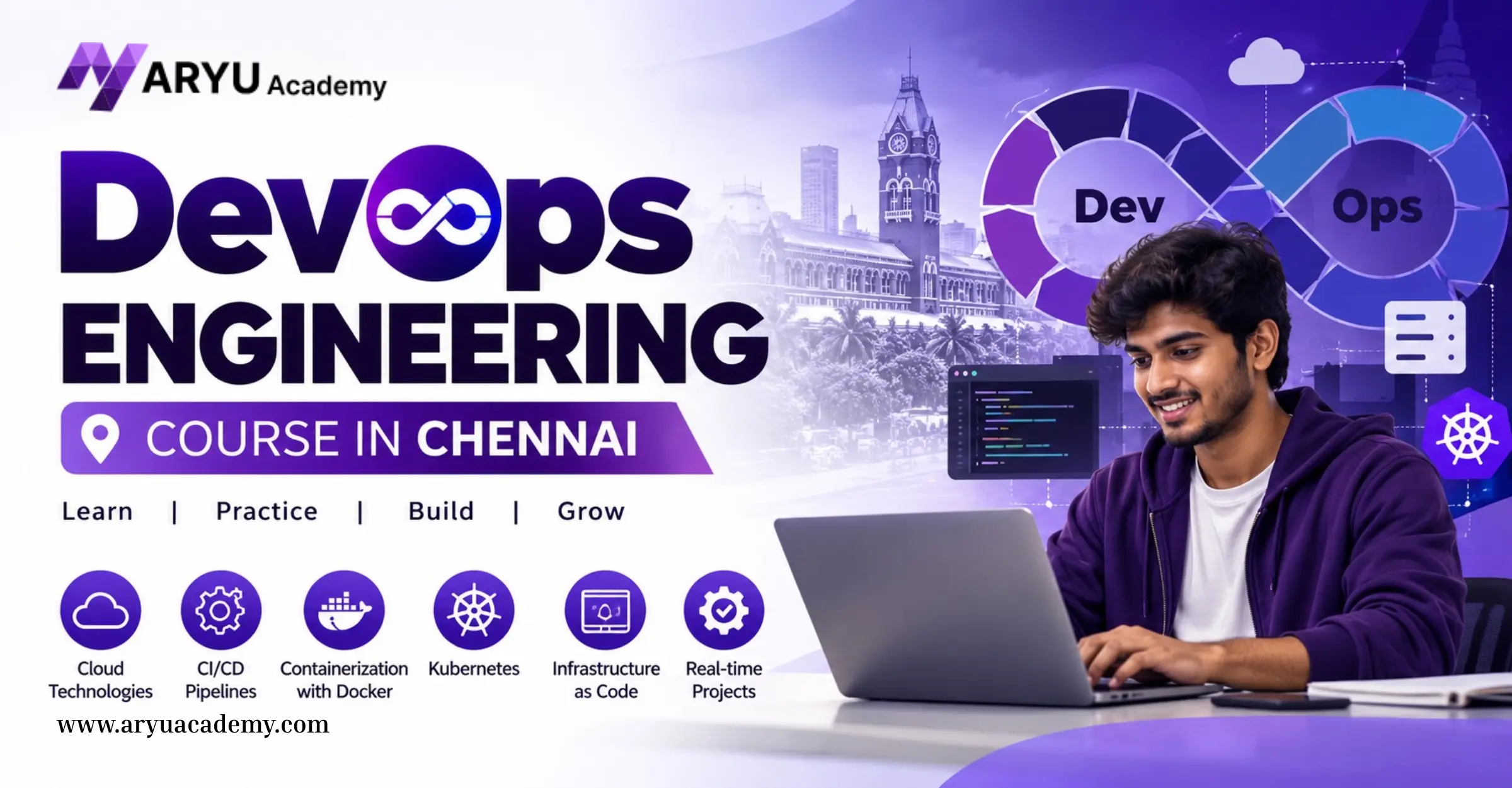
The way software is developed and delivered has changed significantly over the years. Companies today want applications to be developed faster, tested properly, deployed smoothly, and maintained without unnecessary delays. This is where DevOps engineering plays an important role.
If you are a student, recent graduate, working professional, or someone looking to move into the IT industry, learning DevOps can help you understand how development and operations work together in real-world software environments.
Choosing the right DevOps Engineering Course in Chennai can give you practical exposure to important tools, technologies, and workflows used by software teams. Instead of only learning concepts, a good training program should help you understand how these technologies are used in actual projects.
What is DevOps Engineering?
DevOps is a combination of development and operations practices that helps teams build, test, release, and manage software more efficiently.
A DevOps engineer works with different stages of the software development lifecycle. This can include source code management, automated testing, continuous integration, continuous delivery, cloud platforms, containers, monitoring, and deployment.
In simple terms, DevOps helps development and operations teams work together to deliver software faster and more reliably.
Why Learn DevOps Engineering?
Software companies are increasingly using automation and cloud technologies to manage their applications. Because of this, professionals with practical DevOps knowledge can work across different areas of the software delivery process.
Learning DevOps can help you understand:
- How software moves from development to production
- How code is managed using Git
- How CI/CD pipelines are created
- How applications are deployed
- How Docker containers work
- How Kubernetes manages containers
- How cloud platforms are used
- How infrastructure can be managed through code
- How applications are monitored after deployment
The biggest advantage of learning these concepts together is that you begin to understand the complete software delivery process rather than focusing on only one technology.
What Will You Learn in a DevOps Engineering Course?
A practical DevOps Engineering Course in Chennai can cover a range of tools and concepts.
1. Linux Fundamentals
Linux is widely used in development, cloud, and server environments. You can learn basic Linux commands, file management, permissions, processes, networking, and shell scripting.
2. Git and GitHub
Version control is an important part of modern software development. You can learn how to create repositories, manage branches, commit changes, merge code, and collaborate with development teams.
3. CI/CD
Continuous Integration and Continuous Delivery help automate the process of building, testing, and deploying applications.
You can understand how CI/CD pipelines work and how automation can reduce repetitive manual tasks.
4. Docker
Docker allows applications and their dependencies to be packaged into containers.
During training, you can learn about images, containers, Dockerfiles, volumes, networks, and container management.
5. Kubernetes
Kubernetes is used to manage containerized applications at scale.
A practical course can introduce concepts such as pods, deployments, services, namespaces, configuration, and basic cluster management.
6. Cloud Platforms
Cloud technology is an important part of modern DevOps environments. Depending on the course structure, you may get exposure to platforms such as AWS, Microsoft Azure, or Google Cloud.
You can learn how applications, servers, storage, networking, and other resources are managed in the cloud.
7. Infrastructure as Code
Infrastructure as Code allows teams to define and manage infrastructure using configuration files instead of setting everything up manually.
Tools such as Terraform can help you understand this approach.
8. Monitoring and Deployment
DevOps does not end after an application is deployed. Monitoring helps teams understand application performance, errors, and system health.
You can learn the basics of monitoring, logging, troubleshooting, and deployment practices.
Why Choose a Practical DevOps Course in Chennai?
Chennai has a strong IT ecosystem with software companies, startups, service providers, and technology teams working across different domains. This makes it a useful environment for students and professionals looking to develop technology skills.
However, simply watching tutorials or reading documentation may not be enough.
Practical learning can make a major difference.
When you work on projects, you get the opportunity to make mistakes, troubleshoot problems, understand deployment issues, and see how different tools connect with each other.
That experience can help you become more comfortable with real-world DevOps workflows.
Who Can Learn DevOps Engineering?
DevOps is not limited to experienced IT professionals. The course can be useful for people from different technical backgrounds.
It can be suitable for:
- College students
- Recent graduates
- Software developers
- System administrators
- IT professionals
- Cloud beginners
- Testing professionals
- Professionals planning to move into DevOps
- Anyone interested in cloud and deployment technologies
Basic knowledge of computers and programming can be helpful, but the exact prerequisites depend on the training program.
Learn Through Real-Time Projects
One of the best ways to understand DevOps is by working on practical projects.
Instead of learning each tool separately, projects can help you connect different technologies.
For example, a project may involve:
Code → Git → Build → Test → Docker → CI/CD → Cloud → Deployment → Monitoring
Working through this process gives you a better idea of how a DevOps workflow operates in a real software environment.
Career Opportunities After DevOps Training
After developing the required technical skills and practical knowledge, learners can explore roles such as:
- DevOps Engineer
- Cloud Engineer
- DevOps Administrator
- Cloud/DevOps Associate
- Site Reliability Engineering (SRE) roles
- Infrastructure Engineer
- Release Engineer
The actual role you qualify for will depend on your skills, experience, projects, and the requirements of individual companies.
How to Choose the Right DevOps Engineering Course in Chennai?
Before joining a course, don’t look only at the course duration or number of tools listed in the syllabus.
Check whether the training provides:
- Practical sessions
- Real-time projects
- Linux fundamentals
- Git and GitHub
- CI/CD pipeline practice
- Docker and Kubernetes
- Cloud fundamentals
- Infrastructure as Code
- Deployment practice
- Troubleshooting exercises
- Interview preparation
- Guidance from experienced trainers
A course that combines concepts with hands-on practice can make your learning journey more meaningful.
Start Your DevOps Learning Journey
DevOps may look complicated when you first see the number of tools involved. You don’t have to learn everything at once.
Start with the basics. Understand Linux and Git. Then move into CI/CD, containers, cloud, Kubernetes, infrastructure, and monitoring. As you practice, the connection between these technologies becomes easier to understand.
If you are searching for a DevOps Engineering Course in Chennai, focus on learning through practice rather than simply collecting certificates.
The goal is not just to know what a DevOps tool does. The goal is to understand when to use it, how it works with other tools, and how it fits into a real software development workflow.
Frequently Asked Questions
1. What is a DevOps Engineering course?
A DevOps Engineering course teaches the practices, tools, and technologies used to automate software development, testing, deployment, infrastructure management, and monitoring.
2. Is DevOps a good skill for beginners?
Yes. Beginners can learn DevOps by starting with fundamentals such as Linux, Git, networking, and basic scripting before moving into advanced topics like Docker, Kubernetes, CI/CD, and cloud.
3. What are the prerequisites for learning DevOps?
Basic computer knowledge is useful. Familiarity with programming, Linux, networking, or software development can make learning easier, but prerequisites vary between training programs.
4. How long does it take to learn DevOps?
The learning time depends on your existing technical knowledge, the course structure, and how much time you spend practicing. Consistent hands-on practice is important.
5. Does DevOps require coding?
DevOps does not necessarily require advanced programming skills. However, basic scripting and programming knowledge can be very useful for automation and troubleshooting.
Conclusion
DevOps is more than learning a collection of tools. It is about understanding how development, testing, deployment, infrastructure, and operations come together to deliver software.
For students and professionals planning to build a career in cloud and software operations, a DevOps Engineering Course in Chennai can provide a structured path to learn these concepts and practice them through projects.
Start with the fundamentals, practice consistently, build real projects, and gradually expand your knowledge. With the right learning approach, DevOps can become a valuable part of your technology skill set.