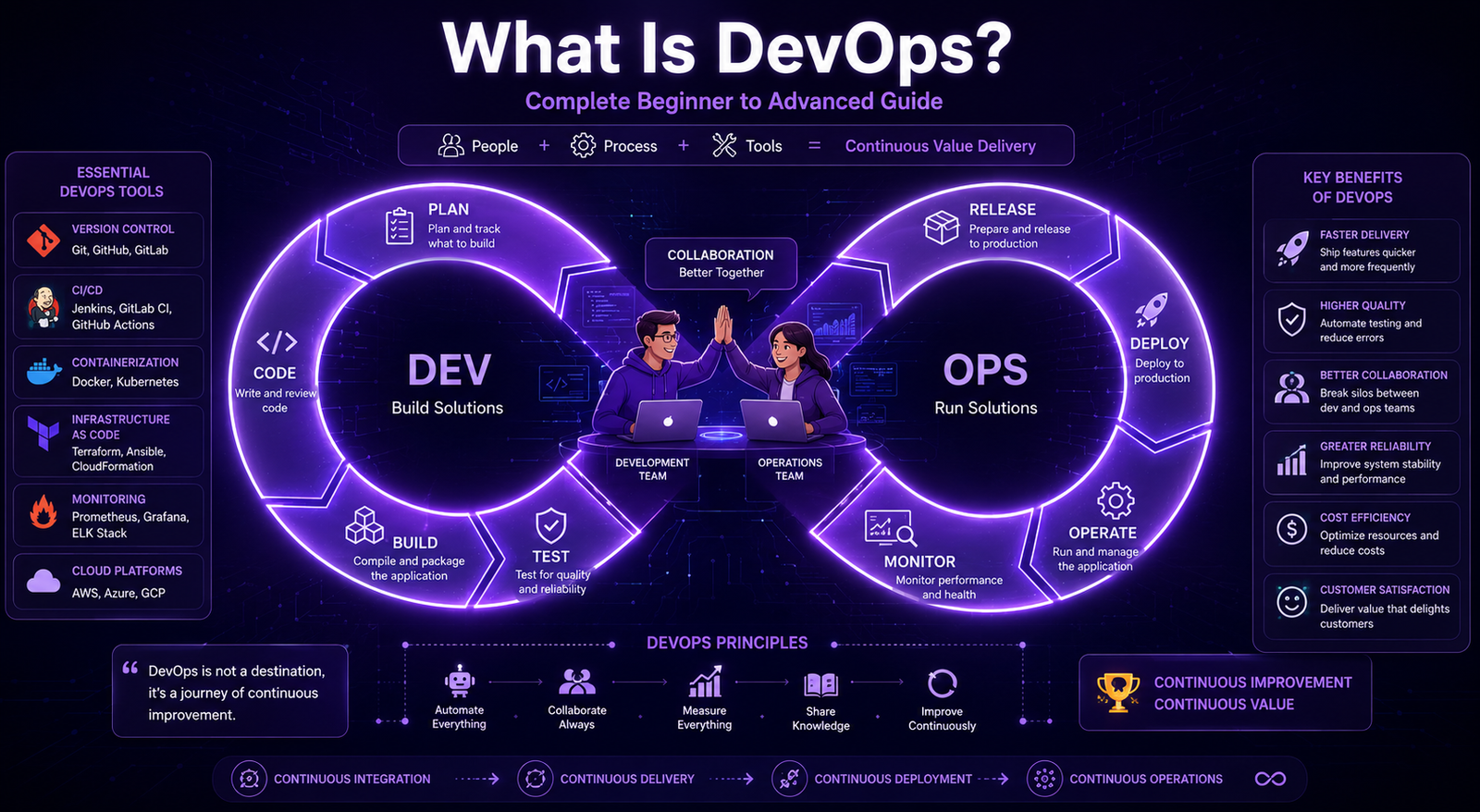
In today’s digital world, software needs to be updated frequently with new features, bug fixes, and security improvements. Traditional software development methods often struggle to keep up because different teams work separately and many tasks are done manually. This is where DevOps becomes important.
DevOps helps organizations build, test, and deliver software faster and more reliably by improving teamwork and using automation.
What Is DevOps?
DevOps is a combination of Development (Dev) and Operations (Ops). It is a modern approach where developers and operations teams work together throughout the software lifecycle.
In simple words, DevOps helps teams deliver software quickly and efficiently through better collaboration and automation. It is not a single tool or language, but a culture supported by practices and tools.
Why DevOps Is Important
Modern applications need regular updates and stable performance. DevOps reduces manual work and speeds up the delivery process. It helps teams find issues early, reduce failures, and keep systems running smoothly. Because of these benefits, startups, enterprises, and cloud-based companies widely use DevOps today.
DevOps vs Traditional Software Development
In traditional development, teams work separately, releases take a long time, and bugs are found late. DevOps improves this by encouraging continuous collaboration, automated testing, faster feedback, and more reliable releases. DevOps focuses on both speed and quality together.
DevOps Lifecycle Explained
The DevOps lifecycle is a continuous process that improves software delivery.
- Planning: Requirements are analyzed and tasks are prioritized
- Development: Code is written, managed, and reviewed
- Build: Code is compiled and dependencies are resolved
- Testing: Automated tests ensure quality
- Deployment: Applications are released automatically with rollback options
- Operations: Infrastructure and uptime are managed
- Monitoring & Feedback: Performance and user feedback improve the next cycle
Core DevOps Concepts
Continuous Integration (CI):
Code is frequently merged and tested automatically to find issues early.
Continuous Deployment (CD):
Tested code is automatically released to production for faster updates.
Infrastructure as Code (IaC):
Servers and infrastructure are managed using code instead of manual setup.
DevSecOps:
Security is included at every stage of the DevOps process.
Conclusion
DevOps has transformed the way modern software is built and delivered. By combining automation, collaboration, and continuous improvement, DevOps helps organizations release high-quality software faster and more reliably. For beginners and IT professionals, learning DevOps opens the door to strong career growth and high-demand opportunities.
Institutions like Aryu Academy support learners by providing structured training, practical knowledge, and industry-relevant guidance. With the right learning path and hands-on practice, anyone can build a successful career in DevOps.