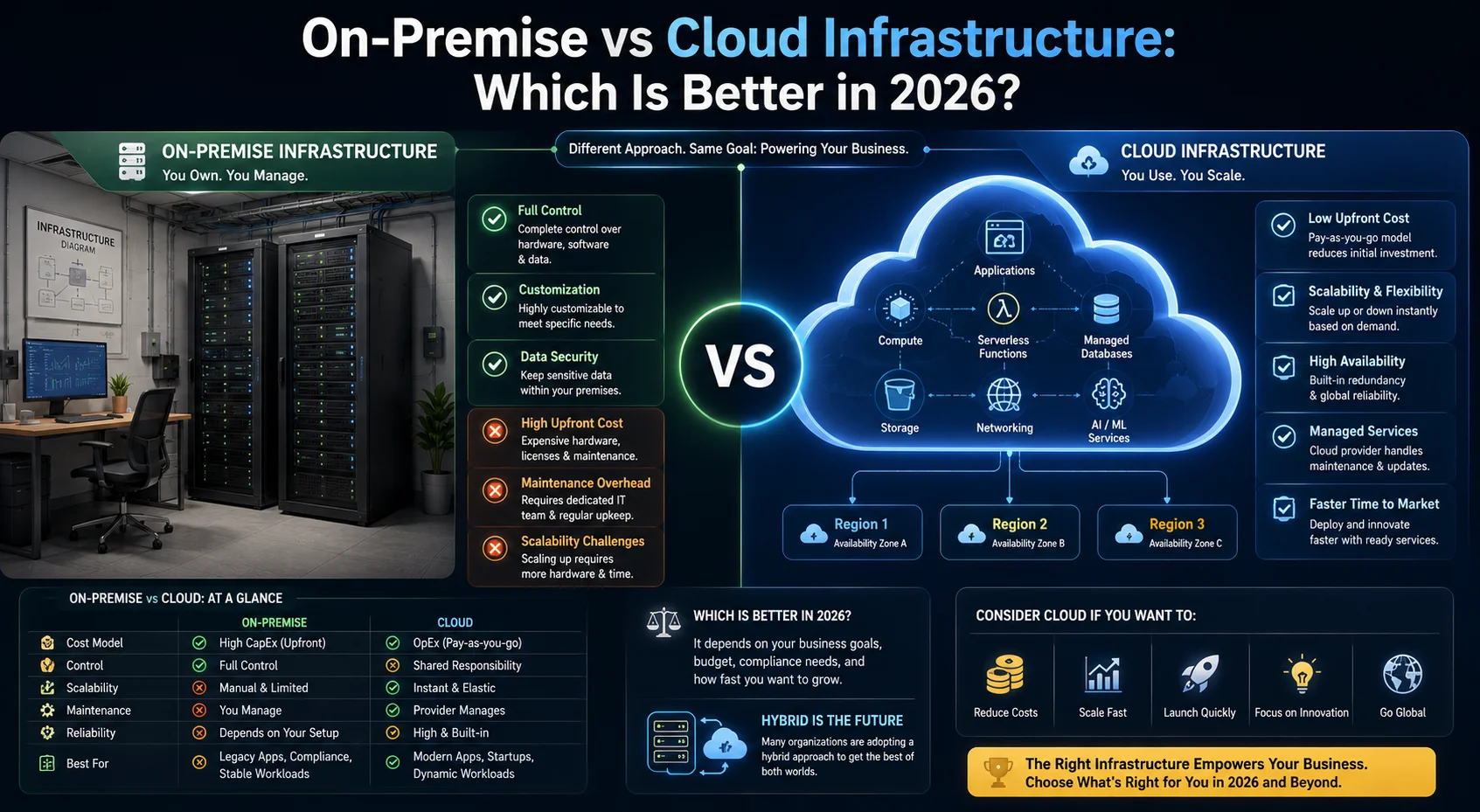
Choosing between On-Premise vs Cloud Infrastructure is one of the most important IT decisions for businesses today. With rapid digital transformation, organizations must evaluate cost, scalability, security, and performance before selecting the right infrastructure model.
In this blog, we’ll compare on-premise infrastructure and cloud infrastructure, explore their advantages and disadvantages, and help you decide which is better in 2026.
What Is On-Premise Infrastructure?
On-Premise Infrastructure refers to IT resources such as servers, storage, and networking hardware that are installed and managed within an organization’s physical location.
Advantages of On-Premise Infrastructure
- Full control over data and systems
- Better for strict compliance requirements
- Predictable performance
- No dependency on internet connectivity
Disadvantages of On-Premise Infrastructure
- High upfront capital investment
- Limited scalability
- Requires in-house IT maintenance
- Slower deployment time
What Is Cloud Infrastructure?
Cloud Infrastructure provides computing resources over the internet through providers such as Amazon Web Services, Microsoft Azure, and Google Cloud Platform.
Benefits of Cloud Infrastructure
- Pay-as-you-go pricing
- Instant scalability
- Faster deployment
- High availability and disaster recovery
- Global accessibility
Limitations of Cloud Infrastructure
- Less direct infrastructure control
- Internet dependency
- Shared responsibility security model
On-Premise vs Cloud Infrastructure: Comparison Table
| Feature | On-Premise Infrastructure | Cloud Infrastructure |
| Cost Model | High upfront CapEx | Pay-as-you-go OpEx |
| Scalability | Limited | Highly scalable |
| Deployment | Slow | Rapid |
| Maintenance | In-house IT team | Managed by provider |
| Security Control | Full control | Shared responsibility |
| Disaster Recovery | Expensive | Built-in |
| Accessibility | Local access | Global access |
Security & Compliance Comparison
- On-Premise is suitable for industries requiring complete data ownership and compliance.
- Cloud platforms provide enterprise-grade security, encryption, and compliance certifications that often exceed traditional setups.
For most businesses, cloud infrastructure is secure when best practices are followed.
Performance & Scalability
- On-Premise works best for fixed and predictable workloads.
- Cloud infrastructure supports dynamic workloads, traffic spikes, and global users.
If scalability and agility are priorities, cloud infrastructure is the better choice.
Hybrid Infrastructure: Best of Both Worlds
A Hybrid Infrastructure combines on-premise and cloud environments:
- Sensitive data remains on-premise
- Applications and analytics run in the cloud
This approach improves flexibility, security, and cost efficiency.
Which Is Better Today?
Choose On-Premise Infrastructure if:
- You need complete control
- Compliance requirements are strict
- Workloads are stable
Choose Cloud Infrastructure if:
- You want scalability and flexibility
- You prefer lower upfront costs
- You need faster deployment
- You are building modern applications
Final Thought
In 2026, cloud infrastructure leads the way with scalability, cost efficiency, and speed, while on-premise remains vital for control- and compliance-driven needs. The smartest approach is a hybrid cloud strategy balancing agility with security.
At Aryu Academy, we prepare learners with the right knowledge and skills to build and manage future-ready cloud and hybrid infrastructures.