If you’re planning a career in software development, one question usually comes up first: **Which learning path should I choose?** You may be considering an in-house training program, a coding bootcamp, or a traditional college degree. Each option can help you build technical skills, but the **cost, time commitment, learning style, and career path** can be very different. The right choice depends on where you are starting, what you want to learn, and how quickly you want to enter the IT industry.
What Is In-House Training?
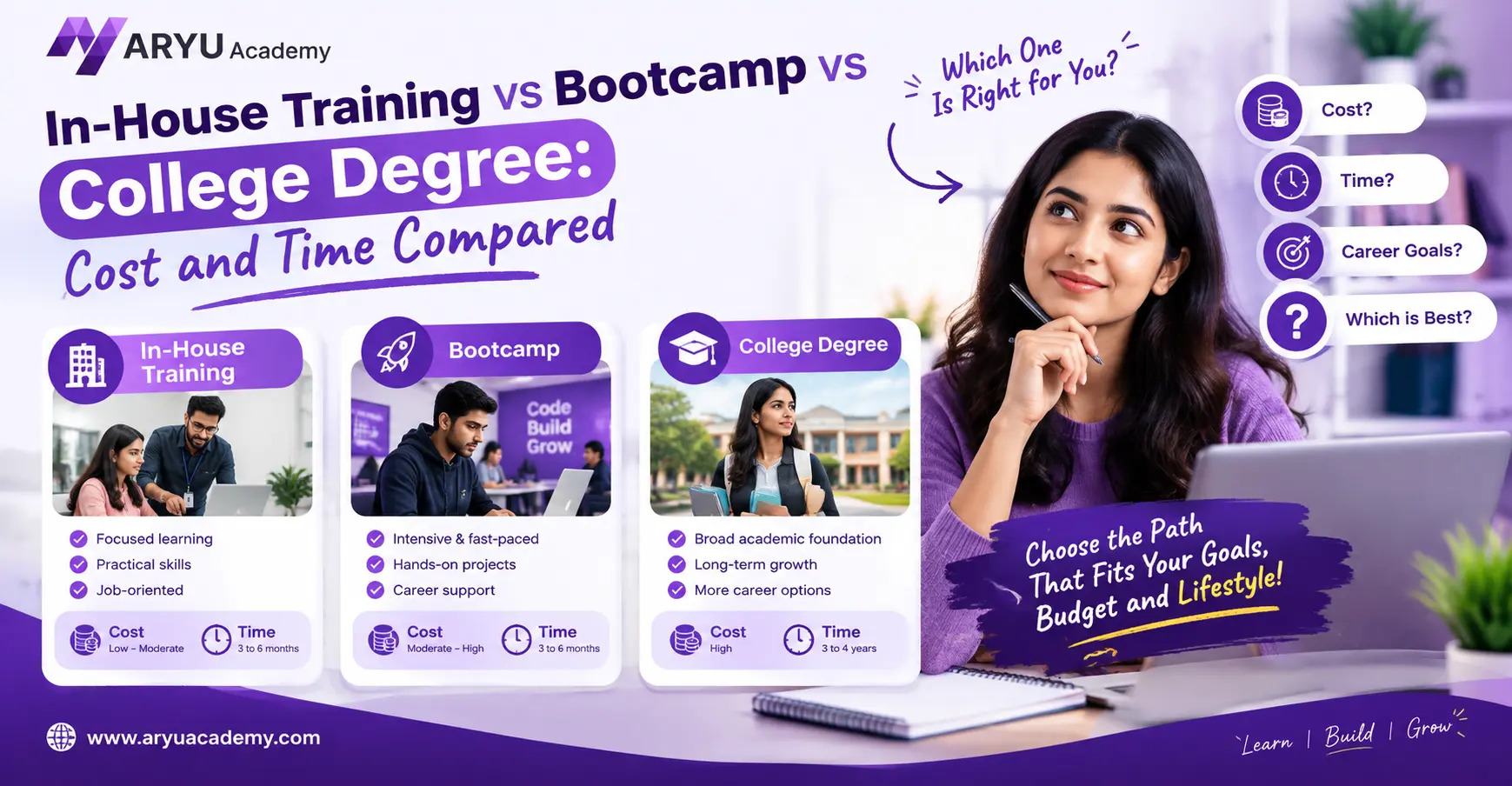
In-house training is a structured learning program provided by a company, training institute, or organization. It usually focuses on practical, job-related skills.
Instead of spending several years studying a broad range of subjects, learners can focus on technologies such as:
* Java or Python
* Web development
* SQL and databases
* Software testing
* Git and GitHub
* Basic development tools
* Real-world projects
The biggest advantage is the focused approach. You spend your learning time working on skills that are directly connected to your target role. For graduates, career switchers, and people who want practical training, this can be a more focused alternative to a long academic program.
What Is a Coding Bootcamp?
A coding bootcamp is an intensive program designed to teach software development skills in a relatively short period. Bootcamps usually involve a fast-paced curriculum covering programming fundamentals, frameworks, databases, projects, and sometimes interview preparation. Because the learning schedule is intensive, students need to be prepared to practice regularly. Bootcamps can be useful for people who already know they want to enter technology and prefer an immersive learning environment. However, the fast pace can also be challenging for complete beginners who need more time to understand programming concepts.
What About a College Degree?
A college degree provides a broader academic foundation. A computer science or related degree can cover programming, databases, operating systems, computer networks, algorithms, mathematics, software engineering, and other subjects.
The major difference is **depth and duration**.
A degree usually takes several years, but it can provide a wider educational foundation and may meet degree requirements for certain employers or further education opportunities. It also gives students time to participate in internships, college projects, clubs, and other activities that can contribute to their overall experience. The actual cost varies significantly depending on the institution, location, course, facilities, curriculum, and other factors. So rather than choosing purely based on price, consider what you are getting for the investment.
In-House Training vs Bootcamp
Both options are generally more focused than a college degree, but their approach can differ.
“In-house training” may provide a more structured learning environment with practical assignments, instructor guidance, and career-focused training.
“Bootcamps” are often designed around an intensive schedule where students cover a large amount of material quickly.
If you prefer learning step by step and need more time to practice, a structured training program may feel more comfortable. If you enjoy an accelerated environment, a bootcamp may suit your learning style.
In-House Training vs College Degree
This comparison mainly comes down to “focus versus breadth”.
A college degree gives you a broader academic education and more time to explore different areas of technology.
In-house training usually concentrates on specific technical skills and practical application.
For someone who already has a degree in another field and wants to move into IT, another multi-year degree may not always be necessary. A focused training program can help them build relevant technical skills without starting their entire education journey again.
Bootcamp vs College Degree
A bootcamp is designed for speed and practical learning, while a college degree provides a much broader academic foundation. With a degree, students typically have more time to study fundamental computer science concepts and explore different areas of technology. With a bootcamp, the focus is often on learning selected skills quickly and applying them through projects. Neither path automatically guarantees a job. Your skills, projects, interview preparation, communication, and ability to demonstrate what you can build all matter.
Which Skills Matter After Training?
Whatever learning path you choose, practical skills can make a major difference.
Try to develop:
* Programming fundamentals
* Problem-solving skills
* Database and SQL knowledge
* Git and GitHub
* Web development basics
* Debugging skills
* Project-building experience
* Communication skills
* Interview skills
Don’t just collect certificates. Make sure you can actually explain and demonstrate what you learned.
How to Choose the Right Path
“Are you starting your education after school?”
A college degree may provide a broader foundation and a traditional academic route.
“Already have a degree but want to enter IT?**
Focused training or a bootcamp may help you build technical skills without committing to another multi-year degree.
“Do you need a fast and intensive learning experience?”
A bootcamp could fit your preferred learning style.
“Do you prefer structured, practical learning?”
An in-house training program may be worth considering.
Your current education, budget, available time, career goal, and learning style should all be part of the decision.
Conclusion
There isn’t one learning path that works for everyone.
A “college degree” offers a broad and longer-term academic foundation. A “bootcamp” focuses on intensive, accelerated learning. **In-house training** can provide a more focused and practical route for developing job-oriented technical skills. The important thing is to choose a path that matches your current situation and career goal. Whichever option you choose, don’t stop at completing the course. “Build projects, practice coding, improve your problem-solving skills, create a portfolio, and prepare for interviews”. Those steps can help turn learning into a real career opportunity.
FAQ
Is in-house training better than a college degree?
They serve different purposes. A degree provides broader academic education, while in-house training generally focuses on specific practical and job-related skills.
Is a coding bootcamp enough to get a software development job?
A bootcamp can help you develop foundational skills, but getting hired also depends on your projects, technical ability, resume, interview performance, and the requirements of individual employers.
Which option takes the least time?
In-house training and bootcamps are generally shorter than a traditional college degree, although the exact duration depends on the program.
Is a college degree necessary for software development?
Not every software development role has the same education requirements. Some employers require or prefer a degree, while others place significant emphasis on practical skills and experience.
Can a non-IT graduate learn software development?
Yes. A non-IT graduate can learn programming and software development through structured training, bootcamps, self-learning, or other educational paths.
Should I choose training or a bootcamp after graduation?
Consider your learning style, budget, schedule, target technology, curriculum, project opportunities, and career support before making a decision.