When you start learning programming, you’ll quickly realize that writing code isn’t just about commands and calculations. A large part of programming involves storing, organizing, accessing, and modifying information. This is where **data structures and strings** become important. Think about a shopping application. It needs to store product names, prices, customer information, orders, and payment details. A social media platform needs to manage usernames, posts, comments, followers, and messages. Behind all of these features are different ways of organizing data. Data structures help programmers arrange information efficiently, while strings allow programs to work with text. Understanding both concepts gives beginners a strong foundation for moving into areas such as software development, web development, data science, automation, and application development.
What Are Data Structures?
A **data structure** is a particular way of organizing and storing information so that a program can access and modify it efficiently. Imagine keeping hundreds of books in a room without shelves or categories. Finding one specific book would take a long time. If those books were organized by subject, author, or title, finding what you need would become much easier. Data structures perform a similar job in programming. They help developers organize information according to the requirements of an application.
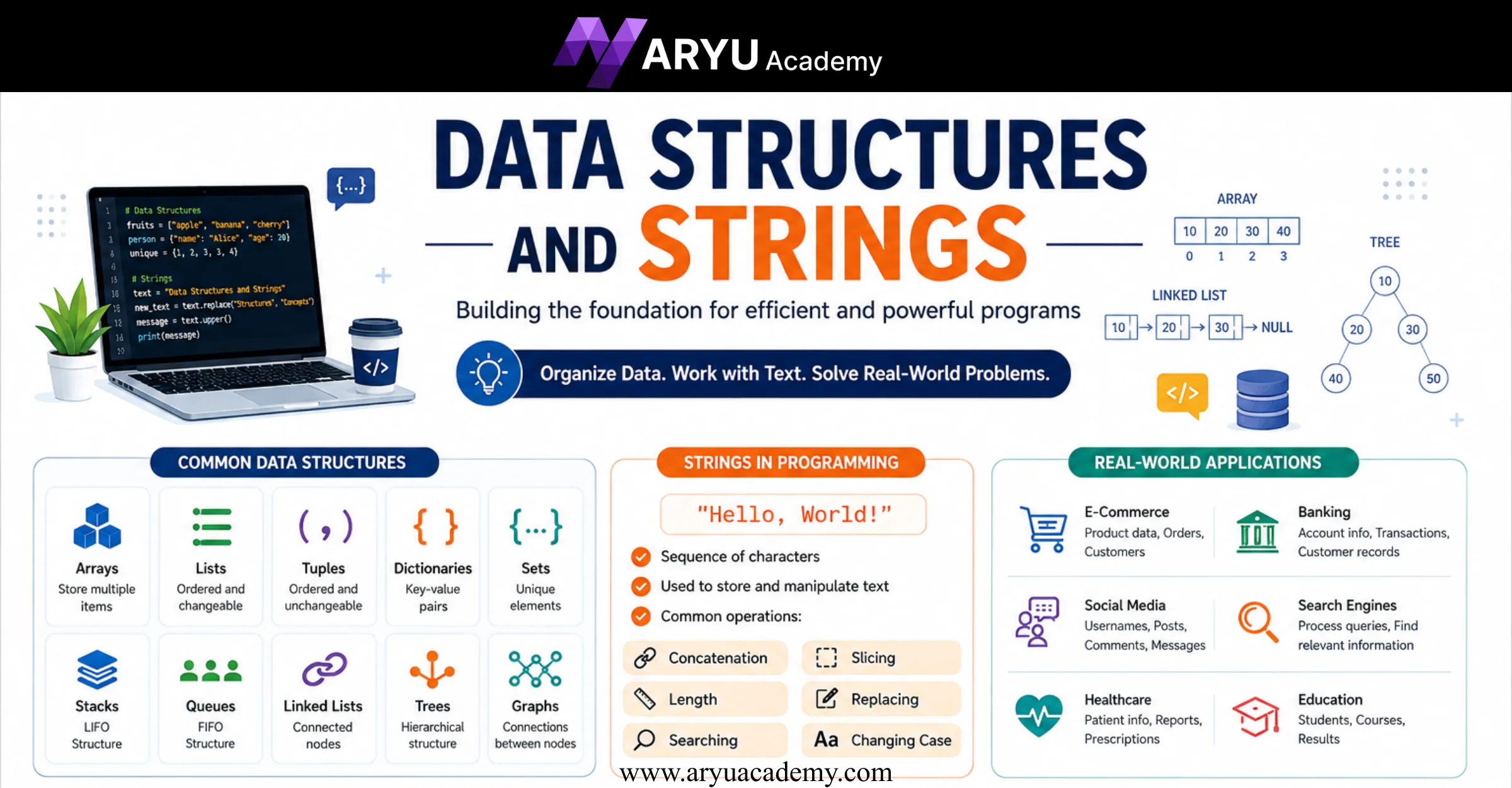
Some commonly used data structures include:
* Arrays
* Lists
* Tuples
* Sets
* Dictionaries
* Stacks
* Queues
* Linked lists
* Trees
* Graphs
Why Are Data Structures Important?
Data structures help developers:
* Store large amounts of information
* Retrieve information efficiently
* Modify data when necessary
* Search and sort information
* Reduce unnecessary processing
* Build scalable applications
* Write organized and reusable programs
Understanding Strings in Programming
Strings can contain letters, numbers, spaces, and special characters. They are among the most commonly used data types because almost every application needs to process text in some form.
Examples of strings include:
`Hello World`
`Welcome to Programming`
`Student123`
`user@example.com`
Programs use strings for information such as:
* Names
* Email addresses
* Password input
* Product descriptions
* Search queries
* Website content
* Messages
* File names
* Addresses
Common String Operations
**Concatenation**
Concatenation combines two or more strings.
**String Length**
Programs can determine how many characters are present in a string. This is useful for validating usernames, passwords, form fields, and other inputs.
**Searching**
Developers can check whether a particular word, character, or pattern exists within a string.
**Replacing**
This is useful when formatting or cleaning text.
**Splitting**
A large string can be separated into smaller pieces. For example, a sentence can be divided into individual words.
**Changing Case**
Strings can often be converted to uppercase or lowercase. This makes comparisons and text formatting easier.
How Data Structures and Strings Work Together
Data structures and strings are often used together rather than separately. A student’s name may be stored as a string, while a collection of student names could be stored in a list. A dictionary could connect each student’s name with information such as their ID, course, or marks.
* Strings for product names
* Lists for product collections
* Dictionaries for product details
* Queues for processing orders
* Sets for storing unique categories
A social media application may use strings for usernames and comments while using lists or other structures to organize followers, messages, and posts.
Real-World Applications of Data Structures and Strings
Data structures and strings are present in almost every type of software.
E-Commerce Applications
Online stores use strings to store product names, descriptions, and customer details. Data structures help organize product catalogs, shopping carts, inventory, and orders.
Banking Applications
Banking software needs to manage customer names, account information, transactions, and financial records efficiently.
Social Media Platforms
Social networks process enormous amounts of text, including posts, comments, usernames, and messages. Advanced data structures also help manage connections between users.
Search Engines
Search systems process strings entered by users and use sophisticated data structures to find relevant information quickly.
Healthcare Systems
Patient names, reports, prescriptions, and medical records need to be stored and retrieved efficiently.
Educational Platforms
Learning systems use data structures to organize students, courses, lessons, assessments, and results while strings handle names, descriptions, and written content.
Practice common string operations such as:* Joining strings
* Splitting text
* Searching for characters
* Replacing words
* Converting letter case
* Extracting parts of strings
Most importantly, build small projects.
* A student record system
* A contact book
* A simple inventory application
* A task manager
* A word counter
* A basic search featureProjects make these concepts easier to understand because you can see how they solve real problems.
Why Learning Data Structures and Strings Matters
Understanding **data structures and strings** is about more than passing programming exams. These concepts teach you how to think about information and choose efficient ways to process it.
A strong understanding can help you:
- Solve programming problems more effectively
- Write cleaner code
- Improve application performance
- Prepare for technical interviews
- Understand algorithms more easily
- Build larger software applications
- Develop stronger problem-solving skills
Conclusion
Data structures and strings are fundamental building blocks of programming. Strings help applications process text, while data structures provide organized ways to store and manage different types of information.
For beginners, the best approach is to learn these concepts gradually and practice them through real examples. Start with strings, lists, arrays, dictionaries, and sets before progressing to more advanced structures such as stacks, queues, trees, and graphs.
The goal isn’t simply to memorize definitions. It’s to understand which structure to use, when to use it, and why it makes your program better.
Once you understand that, you’ll be much better prepared to build efficient applications and tackle more advanced programming challenges.
Frequently Asked Questions
1. What are data structures in programming?
Data structures are methods of organizing and storing information so that programs can access, modify, search, and process it efficiently. Common examples include arrays, lists, stacks, queues, trees, and graphs.
2. What is a string?
A string is a sequence of characters used to represent text. Names, sentences, email addresses, messages, and product descriptions are common examples of string data.
3. Why are data structures important?
Data structures help programs manage information efficiently. Choosing the appropriate structure can improve performance, simplify code, and make applications easier to scale.
4. Is a string considered a data structure?
Depending on the programming language and context, a string can be treated as a data type or a sequence-based data structure. It essentially represents an ordered collection of characters.
5. Which data structures should beginners learn first?
Beginners should usually start with arrays or lists, dictionaries, sets, and tuples where applicable. After understanding these concepts, they can progress to stacks, queues, linked lists, trees, and graphs.