Python is one of the easiest programming languages to learn, but mastering its core concepts can greatly improve the way you write code. Two important features every beginner should understand are the return statement and lambda functions. These concepts make your programs more organized, reusable, and efficient.
The return statement allows a function to send data back to the part of the program that called it, while lambda functions provide a quick way to create small anonymous functions without writing a complete function definition.
Whether you’re building simple applications or working on larger software projects, understanding these concepts will help you write cleaner and more professional Python code.
Understanding the Return Statement
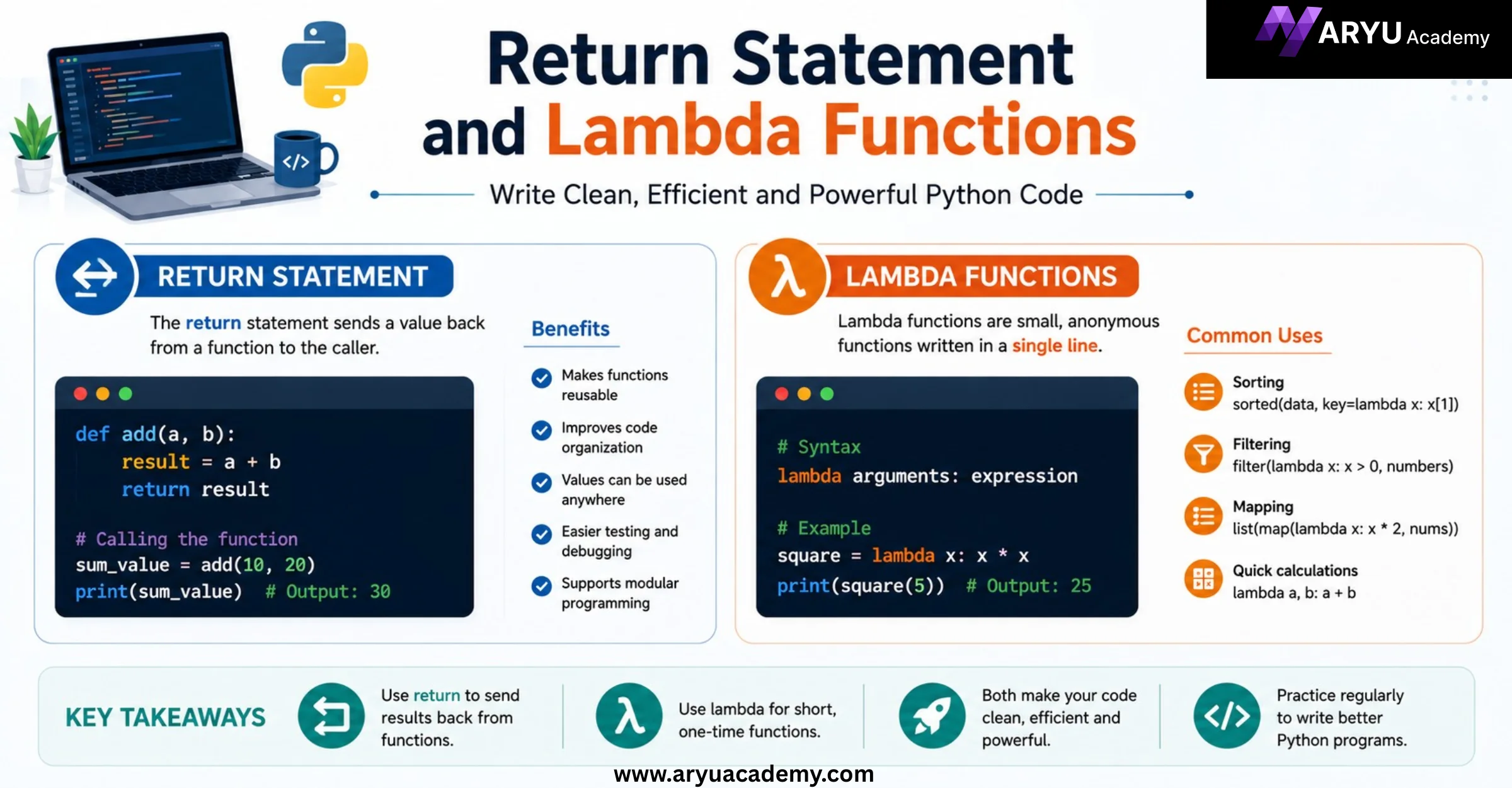
A return statement is used inside a function to send a result back to the caller. Once a return statement is executed, the function immediately stops running and returns the specified value.
Think of a function as a machine. You provide an input, the machine processes it, and the return statement delivers the final output.
- Calculate the sum of two numbers
- Find the largest value in a list
- Convert temperatures
- Validate user input
- Process customer information
Benefits of Using Return Statements
Using return statements offers several advantages:
- Makes functions reusable
- Improves code organization
- Allows values to be stored in variables
- Makes testing and debugging easier
- Supports modular programming
- Enables functions to work together
A well-designed function performs a single task and returns the result for further processing.
What Are Lambda Functions?
A lambda function is a small, anonymous function that can be written in a single line. Unlike regular functions created using the def keyword, lambda functions are designed for short, simple operations.
They are especially useful when a function is needed only once or when passing a function as an argument to another function.
Lambda functions are commonly used for:
- Sorting data
- Filtering lists
- Mapping values
- Performing quick calculations
- Data processing
- Functional programming
Their compact syntax makes code shorter and often easier to read for simple tasks.
Characteristics of Lambda Functions
Lambda functions have several unique features:
- Written in a single line
- Do not require a function name
- Automatically return the result
- Best suited for simple operations
- Can accept multiple input parameters
- Frequently used with built-in functions like map(), filter(), and sorted()
Although they are convenient, lambda functions should only be used for simple logic. Complex operations are better handled using regular functions.
Return Statement vs Lambda Functions
While both concepts involve functions, they serve different purposes.
Return Statement
A return statement is used inside regular functions to send data back after performing one or more operations.
It is ideal when:
- The function contains multiple lines of code
- Complex calculations are required
- Readability is important
- The logic needs to be reused in multiple places
Lambda Functions
Lambda functions provide a quick way to perform simple tasks without creating a full function.
They are ideal when:
- Only a small function is required
- The function will be used once
- Passing functions as arguments
- Working with collections of data
Understanding when to use each approach helps developers write cleaner and more efficient programs.
Real-World Applications of Return Statements and Lambda Functions
These concepts are used extensively in software development.
Web Applications
Return statements send processed data from backend functions to web pages or APIs.
Data Analysis
Lambda functions help transform and filter large datasets quickly.
Machine Learning
Data preprocessing often uses lambda functions for feature transformation.
Banking Applications
Functions return account balances, transaction results, and customer information.
E-Commerce Platforms
Functions calculate discounts, taxes, shipping costs, and order totals before returning results.
Automation Scripts
Lambda functions simplify repetitive tasks involving file processing, sorting, and filtering.
These practical applications demonstrate how important these concepts are in everyday programming.
Best Practices for Using Return Statements and Lambda Functions
To write professional and maintainable code, follow these best practices.
Keep Functions Focused
Each function should perform one specific task and return a meaningful result.
Return Useful Values
Avoid returning unnecessary information. Return only what the program actually needs.
Use Lambda Functions for Simplicity
If the logic fits comfortably in one line, a lambda function can make your code more concise.
Avoid Complex Lambda Expressions
If the operation becomes difficult to understand, switch to a regular function for better readability.
Write Readable Code
Code should be easy for both you and other developers to understand and maintain.
Test Function Outputs
Verify that functions return the expected results under different conditions.
Common Mistakes Beginners Should Avoid
Avoid these common errors:
- Forgetting to use the return statement
- Printing values instead of returning them
- Writing overly complex lambda functions
- Returning incorrect data types
- Using lambda functions where regular functions are more appropriate
- Ignoring function readability
- Creating unnecessary anonymous functions
Why These Concepts Matter in Python Programming
The return statement and lambda functions are fundamental building blocks of Python programming. They improve code quality by making programs:
- More modular
- Easier to maintain
- More reusable
- Faster to develop
- Cleaner and easier to read
Conclusion
The return statement and lambda functions are essential Python concepts that every programmer should master. While return statements allow functions to send meaningful results back to the program, lambda functions provide a concise way to create small, anonymous functions for simple tasks. Knowing when to use each approach helps you write efficient, organized, and professional code. As you continue learning Python, practice combining return statements with regular functions and use lambda functions where they genuinely simplify your code. With consistent practice, these concepts will become second nature and significantly improve your programming skills.
Frequently Asked Questions (FAQs)
1. What is a return statement in Python?
A return statement sends a value from a function back to the part of the program that called it. It also immediately ends the execution of that function.
2. What is a lambda function?
A lambda function is a small anonymous function written in a single line. It is commonly used for simple operations and functional programming tasks.
3. When should I use a lambda function instead of a regular function?
Use a lambda function when the logic is simple, short, and needed only once. For more complex tasks, regular functions created with def are easier to read and maintain.
4. Can a lambda function return a value?
Yes. A lambda function automatically returns the result of its expression without requiring a separate return statement.
5. Why are return statements important?
Return statements make functions reusable, improve code organization, simplify debugging, and allow the returned values to be used in other parts of the program, making applications more modular and efficient.