How to Learn Data Science with Python and Get a Job in 6 Months
Follow a 6-month roadmap to learn Data Science with Python, build real projects, master ML, and become job-ready with Aryu Academy’s hands-on training aid.
How to Learn Data Science with Python and Get a Job in 6 Months
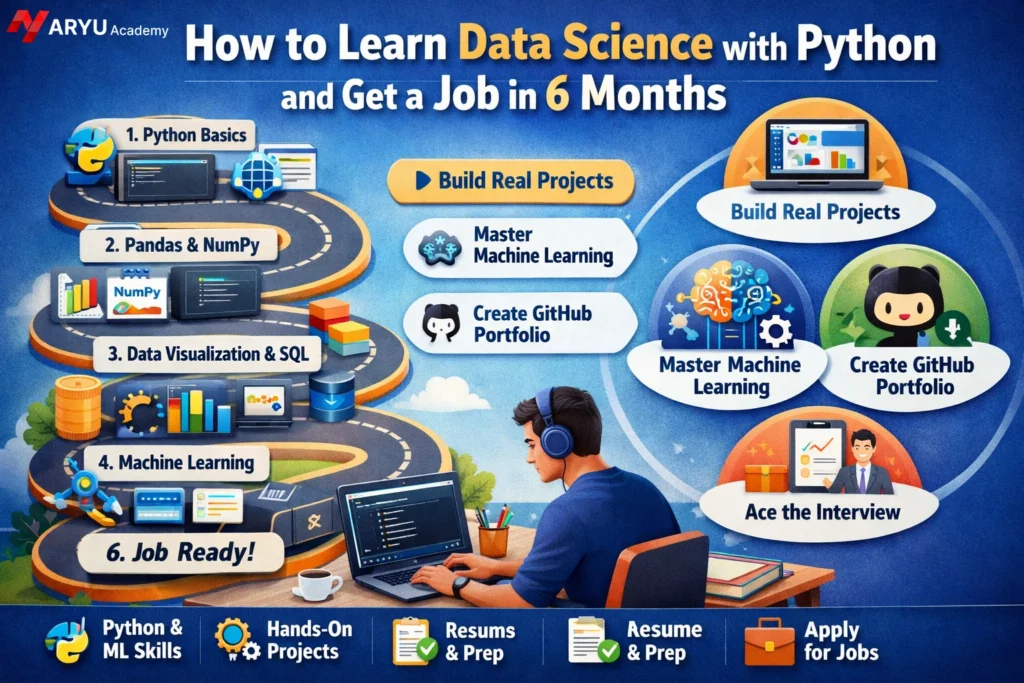
Data Science is one of the most in-demand career paths for students and freshers in 2026. Companies expect candidates who can work with real data, build models, and explain insights clearly — not just people with certificates.
Many learners feel confused about what to learn, in what order, and how much is enough. This 6-month roadmap gives you a clear, practical path to become job-ready in Data Science using Python, projects, and interview preparation.
Month 1 — Learn Python Programming Fundamentals
In the first month, your focus should be on getting comfortable with Python programming without hesitation. Start with the basic building blocks like variables, loops, functions, lists, dictionaries, tuples, and simple object-oriented concepts. Avoid just watching tutorials—practice coding every day. By the end of the month, you should be confident writing Python code on your own.
What to learn:
- Variables, loops, and functions
- Lists, dictionaries, and tuples
- Basic OOP concepts
- File handling in Python
Practice tasks:
- Solve beginner coding problems daily
- Write 30–40 small Python programs
Mini project:
- Build a Student Record System using Python
Month 2 — Data Analysis with Pandas and NumPy
Now that you know Python, start working with real datasets. Learn how to use Pandas and NumPy to clean, organize, and analyze data. Understand how to handle missing values, remove duplicates, and perform calculations on datasets.
What to learn:
- Pandas DataFrame operations
- Data cleaning techniques
- NumPy arrays and calculations
- Reading CSV and Excel files
Practice tasks:
- Download datasets from Kaggle
- Perform data cleaning and summary analysis
Mini project:
- Sales Data Analysis Project
Month 3 — Data Visualization and SQL
This month focuses on presenting data visually and learning how databases work. Visualization helps you tell stories with data, and SQL helps you retrieve data from databases, which is a core skill in interviews.
What to learn:
- Matplotlib and Seaborn charts
- Bar charts, line charts, histograms, heatmaps
- SQL basics: SELECT, WHERE, JOIN, GROUP BY
Practice tasks:
- Visualize cleaned datasets
- Practice SQL queries daily
Mini project:
- E-commerce or IPL Data Dashboard
Month 4 — Machine Learning with Scikit-learn
Here you start learning how machines make predictions from data. Focus on understanding basic ML algorithms and how to apply them using Scikit-learn.
What to learn:
- Linear Regression
- Logistic Regression
- KNN, Decision Tree, Random Forest
- Train/Test split, Accuracy, Confusion Matrix
Mini projects:
- House Price Prediction
- Spam Email Classifier
Month 5 — Portfolio Projects (Very Important)
This is the most important month. You will build complete end-to-end projects and upload them to GitHub. These projects act as proof of your skills for recruiters.
Do any 3–4 projects:
- Customer Churn Prediction
- Loan Approval Prediction
- Sales Forecasting
- Movie Recommendation System
- Fake News Detection
Each project must include:
- Problem statement
- Data cleaning
- Visualization
- Model building
- Results and explanation
Month 6 — Resume, Interview Preparation, and Job Applications
Now you prepare to face interviews and start applying for jobs confidently.
What to do:
- Create a one-page Data Science resume
- Upload all projects to GitHub
- Practice Python, Pandas, and SQL questions
- Prepare to explain every project clearly
- Apply to 15–20 jobs daily
Daily Study Routine (2–3 Hours)
| Time | Activity |
| 45 mins | Learn concepts |
| 45 mins | Coding practice |
| 45 mins | Project work |
| 15 mins | Revision |
Tools You Will Use
- Python
- Pandas, NumPy
- Matplotlib, Seaborn
- Scikit-learn
- SQL
- Jupyter Notebook / VS Code
- GitHub
What Recruiters Look For
- Strong Python and Pandas knowledge
- Basic understanding of Machine Learning
- Real projects on GitHub
- SQL confidence
- Clear explanation of your work
Final Thoughts
You don’t need 10 certificates to become a Data Scientist in 6 months. You need consistent practice, real projects, and clarity. Follow this roadmap step by step, avoid distractions, and focus on building proof of your skills.
If you’re looking for structured guidance, hands-on practice, and mentorship, Aryu Academy helps students learn Data Science step by step with real-time projects and industry-focused training to accelerate their career.

Subscribe to Our Newsletter!
Get The Latest News, Updates, And Amazing Offers
Popular Posts

Mar 24, 2026
Python Course After 12th: Scope,Salary & Career Roadmap in 2025

Mar 3, 2026
React JS vs React Native: What’s the Difference and Which One Should You Learn?

Feb 25, 2026
How AI & LSTM Models Detect Cyber Threats in Real Time
Popular Tags